On this page
Cozy Grove does not have a hard economy. You cannot fail a season or miss a mortgage payment. But the difference between a comfortable camp and a scrappy one is mostly sequence: knowing what to keep until bear requests are read, what to process, and what to donate before selling.
This guide is built around repeatable income rather than one-time windfalls. It uses community-documented prices where Spry Fox does not publish an official price list, and it says so.
Rule zero: read the quests first
Spry Fox’s own beginner tips include a recommendation that applies to every economy decision:
Wait until you get all of your quests for the day before selling, burning, or otherwise transforming your resources. You might realize that you needed them for a quest!
That single habit prevents the most common self-inflicted setback. A stack of fruit is worth 15 coins until it is the last ingredient a bear needs and you have already cooked it into something else.
The five reliable income streams
1. Farming and cooking
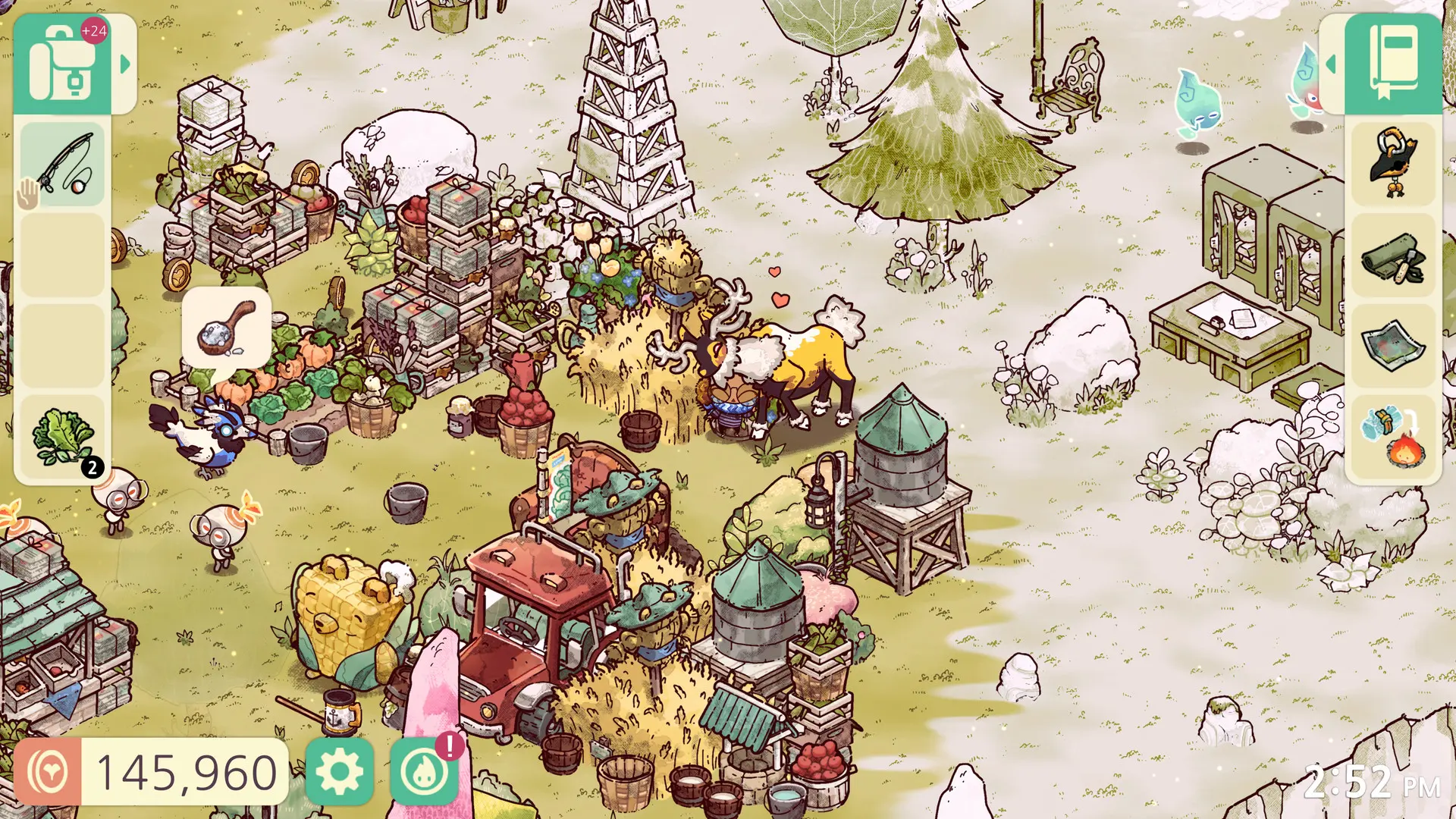
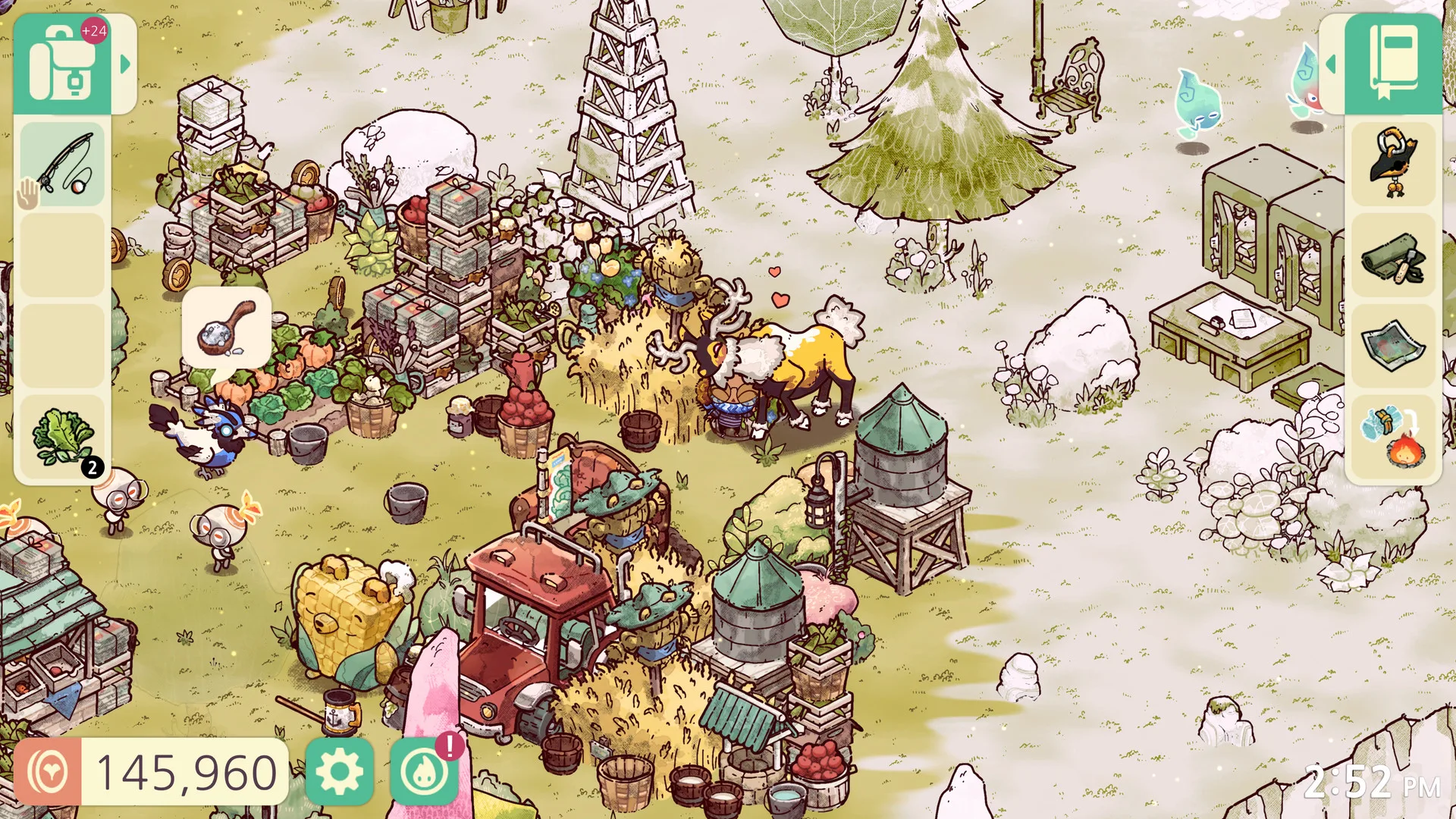
Trees, bushes and flowers that are colored and happy produce more over time. Spry Fox describes happiness as a chance for better rewards, not a guarantee, and notes that nearby objects’ attributes affect it. The practical routine is simple: place plants where they receive the light and nearby decorations they prefer, harvest daily, and replant what you actually use.
Cooking turns harvested ingredients into dishes that can be sold, donated or used in requests. Allison’s kitchen is the practical hub, but Flamey’s burning step comes first for many ingredients.
2. Fishing and charred fishbones
Fishing is available after buying a rod, and it remains useful throughout the game. Fish can be:
- sold raw,
- burned at Flamey into charred fishbones, which are used for repairs and recipes,
- donated once to Captain Snout’s collection,
- or kept for a bear’s request.
The right choice depends on what you need. Charred fishbones are a crafting and repair material, not just a coin token. Burn surplus fish after you have donated a new species and checked the day’s quests.
3. Foraging and processing
Fruit, mushrooms, root vegetables, nuts and flowers all have processed forms. The general rule is that a processed good sells for more than the sum of its raw ingredients. The exception matters: some recipes are deliberately bad conversions if your only goal is coins.
4. Crafting decorations
Some decorations can be crafted from cheap, renewable materials and sold. The community guide records a set of fishbone recipes with a 2,000-coin sale value, but recipe availability is random and the economy changes by platform/version. Treat crafted decor as a way to use surplus materials, not a guaranteed money printer.
5. Collections and badges
Early on, donations and merit badges are excellent income. Spry Fox notes that badge rewards are not repeatable, and collection donations are one-time per item. Do not confuse a large one-time payout with a renewable farm.
Community-documented processing chains
Prices below are from the community-maintained Cozy Grove Wiki and should be treated as a planning reference, not a promise. Recipes can require other ingredients, and platform versions may differ. Do the full chain only if you already have the recipe and the intermediate ingredients are genuinely surplus.
| Chain | Raw/processed values | What the numbers suggest |
|---|---|---|
| Roasted fruit → fruit jam → fruit tincture | 160 → 1,920 → 24,000 coins | The full chain is one of the strongest value multipliers, but it consumes a lot of fruit and several processing steps. |
| Roasted mushrooms → mushroom tofu → mushroom tamari | 240 → 2,880 → 12,000 coins | Stop at tofu for profit. The tamari step loses value if you are selling the output. |
| Roasted root vegetables → vegetable broth → fancy broth | 100 → 2,500 → 10,000 coins | Vegetable broth is the useful margin. Fancy broth is not a coin-efficient endpoint. |
| Fancy greens → deluxe greens | 288 → 3,600 coins | A solid multiplier on paper, but only worth making when the inputs are surplus. |
Scroll the table sideways to see every column.
The pattern is more useful than the exact numbers: check the value at each step, not just the final dish. A 24,000-coin tincture is not automatically a good use of a rare fruit if a bear is asking for the raw ingredient.
Fish: sell, burn or donate?
The decision tree is short:
- New species? Donate it to Captain Snout’s collection first. The one-time reward is usually better than an early sale.
- Open quest? Keep it. A quest turn-in beats a few coins.
- Surplus and need crafting materials? Burn it into charred fishbones.
- Surplus and need coins now? Sell the raw fish if the sale prompt is high enough.
Some fish are exceptions to the usual price bands. The Fish Finder lists each fish’s own sale price and burn yield rather than assuming every fish in a rarity band behaves identically.
Our fishing guide has the full rarity/size table and the seasonal rotation rules. The short version: don’t burn a fish you have not donated, and don’t sell a fish you have not checked against the evening’s quests.
Donations: the best early return
Captain Snout’s collection accepts many categories: fish, shells, critters, flowers and more. Once the collection is unlocked, each eligible item can be donated once and rewards coins and sometimes quartz.
That makes new discoveries worth more than their shop price. A new common fish may sell for very little, but its collection reward is a useful early payday. The same logic applies to shells, critters and seasonal flowers.
Do not overthink it: donate first, duplicate later. If you are short on coins, a one-time collection reward is exactly what you need to unlock the next tool or storage upgrade.
A 20-minute money routine
This is the low-effort version of the economy, not a maximum-efficiency spreadsheet.
- Read quests and mail. Identify any item you must not sell.
- Harvest the visible farm and pet loop. Feed hungry animals; harvest colored plants.
- Do a short fishing or critter run if you want new collection entries.
- Process one surplus chain. Pick one: fruit, mushrooms or roots. Do not start a chain you cannot finish today.
- Check the shops for a cheap tree/bush or a missing tool. Don’t buy decor just because it’s there.
- Burn/sell the remainder only after step 1.
That is a reasonable routine for a normal evening. If you want to log off earlier, skip step 4.
What to spend your first coins on
The first few thousand coins are better spent on capacity and access than on decoration:
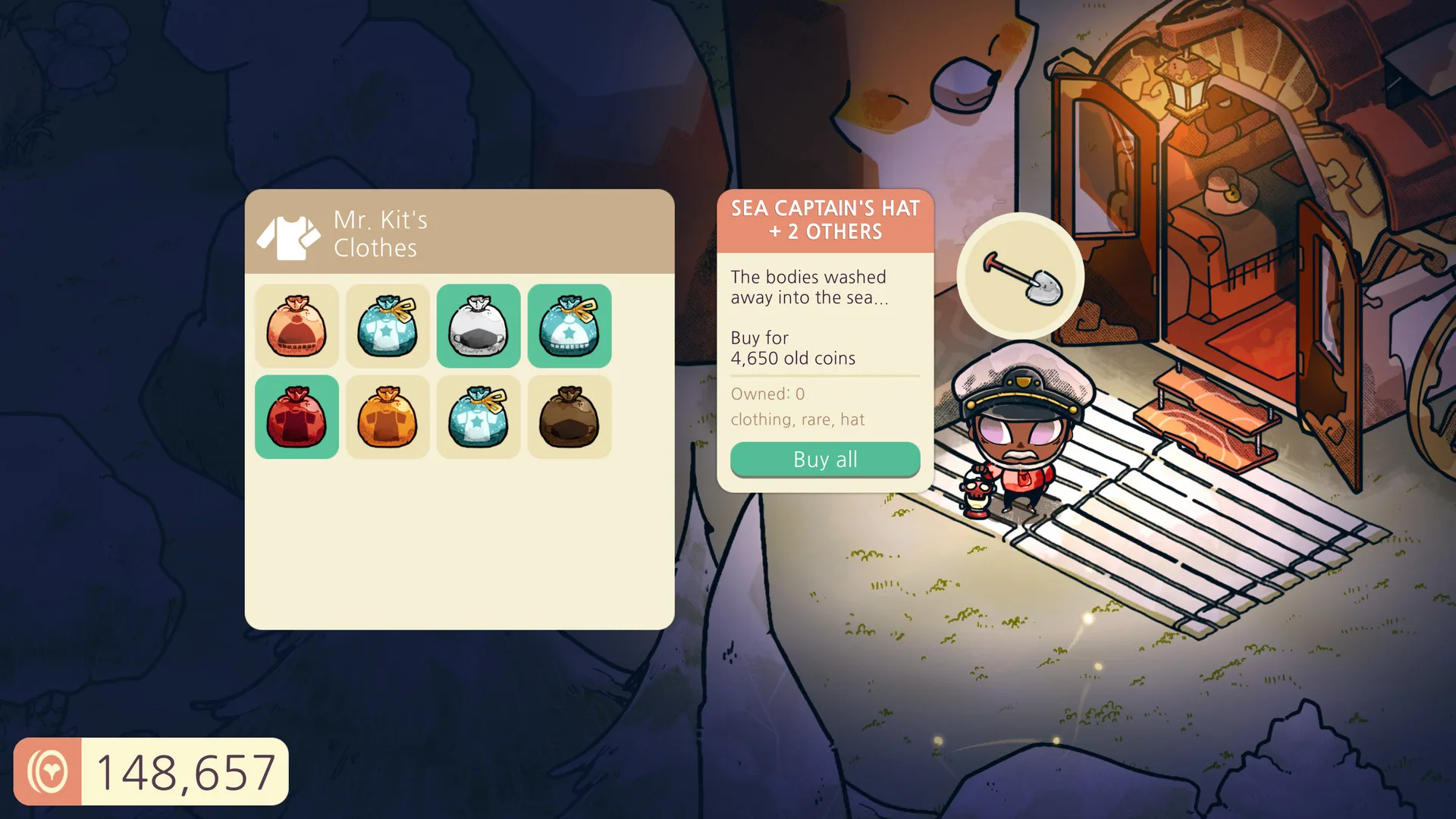
- Fishing rod: 20 coins from Mr. Kit; required for the Captain’s lessons and a major food/income loop.
- Critter net: a one-time tool purchase; useful for donations and quests.
- Tool upgrades and repairs: efficient harvesting and fewer interruptions.
- Fruit trees or berry bushes: a renewable food source, when the daily stock offers one you need.
- Backpack or storage upgrades: less time shuffling items, more time playing. These become expensive; buy when you feel the constraint.
- A Spirit Log from Kit (from day 14, community-documented): useful when you are one log short of a resident, but not a reason to skip the daily quest loop.
Decorations are part of the game’s emotional payoff. Just don’t let a beautiful camp prevent you from affording the shovel upgrade that would have made harvesting it possible.
Three ways people waste materials
Burning before reading. The biggest one. Burn surplus, not the unknown.
Converting everything to the final, most expensive item. The final item may require 25 inputs and a recipe you do not have. Selling an intermediate good can be the better call.
Hoarding one-time rewards. Don’t leave a new fish in storage for a month while you wait for the “perfect” collection strategy. The reward helps now. Donate it.
The honest conclusion
There is no need to grind in Cozy Grove. The game gives you enough time between story beats to earn what you need through ordinary play. If you want more coins, improve the habit that produces them: harvest reliably, donate new finds, process only what you can use, and check the quest board before the shop counter.
That is less exciting than a secret fish exploit, but it also doesn’t stop being true when a patch changes a recipe.
Sources & notes
Linked, dated and labeled
Official sources are used for platform facts, schedule rules and mechanics. Community data is labeled because it is maintained by players rather than Spry Fox.
- Official · Spry Fox Support Tips for getting started in Cozy Grove New-day timing, saving, island structure, color, tools, pets, economy, shell limits, cross-device caveats.
- Community · Fandom contributors Cozy Grove Wiki Community-documented bear roles, quest mechanics, item prices, festival dates, spirit-log requirements. Fan-maintained and not endorsed by Spry Fox. Values reproduced on this site are labeled where they are community data.
- Community · Cozy Grove Wiki contributors Fish (Cozy Grove) The 180-fish dataset: season cohort, size, behavior, rarity, sale price and burn yield. Each fish row was collected from its individual community wiki page on 2026-11-09.
- Community · Cozy Grove Wiki contributors Bear (Cozy Grove) Bear unlock order, location descriptions, services, story context and replacement mappings.
- Store listing · Valve / Spry Fox Cozy Grove on Steam Platform, release date, price, features, system requirements, screenshots.